17 Fit Calculators BMR calculator
BMR calculator basal metabolic rate and total daily energy expenditure (TDEE)
Enter your sex, age, height and weight to see how many calories your body burns at rest, by three formulas, and how many you burn in a whole day at each activity level.
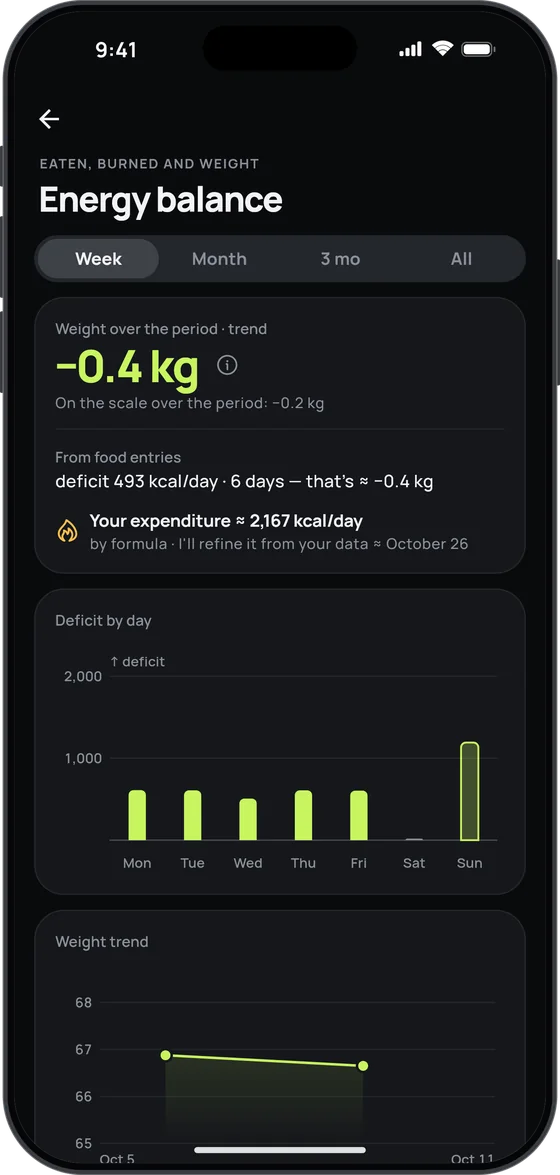
Formulas are averages. Your real expenditure can be 10 % higher or lower. 17 Fit starts from Mifflin–St Jeor, then compares what you eat with how your weight moves and learns what you really burn.

Your basal metabolic rate
1,370 kcal a day
Mifflin–St Jeor, the formula 17 Fit uses
- Harris–Benedict
- 1,430 kcal
- Katch–McArdle
- enter body fat %
- At rest, per hour
- 57 kcal
- TDEE at your activity level
- 1,884 kcal
TDEE by activity level
| Activity | Factor | kcal a day |
|---|---|---|
| Minimal | 1.2 | 1,644 |
| Light | 1.375 | 1,884 |
| Moderate | 1.55 | 2,124 |
| High | 1.725 | 2,364 |
| Very high | 1.9 | 2,603 |
Enter an age of 15 to 90, a height of 120 to 230 cm, a weight of 35 to 250 kg and, if you like, a body fat of 3 to 60 %.
Basal metabolic rate: 1,370 kcal a day. Total daily energy expenditure: 1,884 kcal a day.
What your day’s calories are made of
Your total daily energy expenditure (TDEE) has four parts. The calculator gives the first; the activity factor covers the other three.
- Basal metabolic rate The energy for breathing, circulation, the brain and keeping warm while you lie at rest — usually 60–70 % of the day’s calories.
- Digesting food Breaking down and storing food uses about 10 % of the calories you eat: more for protein, less for fat.
- Everyday movement Walking, standing, housework, fidgeting. It’s the part that varies most between people, by hundreds of calories a day.
- Exercise Workouts and sports. For most people it’s a smaller share than everyday movement.
Three formulas compared
All three estimate the same thing in different ways. Weight in kg, height in cm, age in years.
| Formula | How it works |
|---|---|
| Mifflin–St Jeor (1990) | 10 × weight + 6.25 × height − 5 × age, then + 5 for men or − 161 for women. Close to measured values for most adults; 17 Fit uses it. |
| Harris–Benedict, revised (1984) | Men: 88.362 + 13.397 × weight + 4.799 × height − 5.677 × age. Women: 447.593 + 9.247 × weight + 3.098 × height − 4.330 × age. Tends to come out a little higher than Mifflin–St Jeor. |
| Katch–McArdle | 370 + 21.6 × lean body mass. Counts only the fat-free mass, so it needs your body fat percentage; it suits lean, muscular people best. |
Basal metabolic rate by age
By Mifflin–St Jeor, for a woman (165 cm, 65 kg) and a man (180 cm, 80 kg). Each decade of age lowers it by 50 kcal a day.
| Age | Woman | Man |
|---|---|---|
| 20 | 1,420 | 1,830 |
| 30 | 1,370 | 1,780 |
| 40 | 1,320 | 1,730 |
| 50 | 1,270 | 1,680 |
| 60 | 1,220 | 1,630 |
| 70 | 1,170 | 1,580 |
Questions and answers
What is basal metabolic rate?
The calories your body burns in a day at complete rest: for breathing, the heartbeat, the brain, the kidneys and keeping warm. It’s the largest part of the day’s expenditure, but not all of it.
What’s the difference between BMR and TDEE?
BMR is the body at rest. TDEE, total daily energy expenditure, adds digestion, everyday movement and exercise: it’s BMR times an activity factor, from 1.2 to 1.9. TDEE is the number that keeps your weight steady.
Which formula is the most accurate?
For most adults, Mifflin–St Jeor comes closest to measured values, usually within about 10 %. Katch–McArdle can do better for lean, muscular people, if their body fat percentage is known. Only a lab measurement is exact.
Should I eat at my BMR to lose weight?
Not as a rule: your target comes from TDEE, not BMR. 17 Fit sets the weight-loss target at about 20 % under TDEE and never below 1,200 kcal a day for women or 1,500 for men; the calorie calculator works it out for you.
Why does my BMR drop as I lose weight?
A lighter body needs less energy: by Mifflin–St Jeor, each kilo you lose takes 10 kcal a day off your BMR. That’s why a plan needs updating as your weight changes.
Does muscle raise your BMR?
A little: at rest a kilo of muscle burns roughly 13 kcal a day, a kilo of fat about 4.5. Strength training helps keep muscle while you lose weight.
Who is the calculator not for?
Pregnant and breastfeeding women, children and teenagers, and people with thyroid disease or other conditions that change metabolism. They’re better off working out their numbers with a doctor.
17 Fit
From a formula to what you really burn
17 Fit starts with Mifflin–St Jeor and your activity, then reads your steps and weigh-ins and adjusts the plan to the energy you really use.
- Energy balance: what you eat against what you burn
- Calories and macros from a photo of your plate
- Free food diary, no sign-up and no ads