17 Fit Calculators kJ to kcal converter
kJ to kcal converter kilojoules to kilocalories and back
Type a figure in either field and the other one follows. Food labels in Europe, Australia and New Zealand show energy in kilojoules first; calorie counters count in kilocalories.
1 kcal = 4.184 kJ: divide kilojoules by 4.184 to get kilocalories, or multiply kilocalories by 4.184 to get kilojoules.
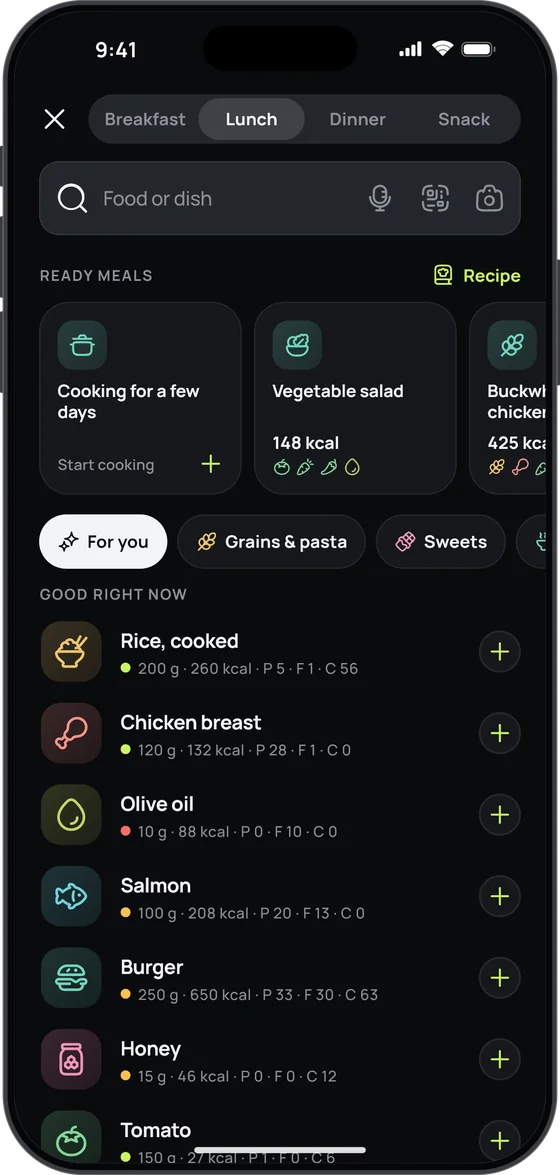
Counting from labels? 17 Fit reads the macros straight off a photo of the nutrition label, so you don’t have to convert anything.

In kilocalories
239 kcal
1,000 kJ = 239 kcal
Enter 4 to 104,600 kJ or 1 to 25,000 kcal.
1,000 kJ = 239 kcal
Why a label’s kJ and kcal don’t always match
An EU label doesn’t convert one figure into the other. It works out both from the nutrients, each with its own factor, so the kJ figure can be a little off from kcal × 4.184.
The EU’s energy factors
| Nutrient | kJ per gram | kcal per gram |
|---|---|---|
| Carbohydrates (except polyols) | 17 | 4 |
| Protein | 17 | 4 |
| Fat | 37 | 9 |
| Fibre | 8 | 2 |
| Alcohol (ethanol) | 29 | 7 |
| Polyols | 10 | 2.4 |
| Organic acids | 13 | 3 |
| Salatrims | 25 | 6 |
| Erythritol | 0 | 0 |
100 g of a wholegrain cracker, worked out
| Nutrient | g | kJ | kcal |
|---|---|---|---|
| Fat | 5 | 185 | 45 |
| Carbohydrates (except polyols) | 60 | 1,020 | 240 |
| Fibre | 4 | 32 | 8 |
| Protein | 10 | 170 | 40 |
| On the label | 1,407 | 333 |
The label says 1,407 kJ and 333 kcal, yet 333 × 4.184 is 1,393 kJ: 14 kJ apart, because the factors are rounded per nutrient. Both figures are right.
Quick conversion tables
Common figures in both units, rounded to whole numbers.
| kJ | kcal |
|---|---|
| 100 | 24 |
| 250 | 60 |
| 500 | 120 |
| 1,000 | 239 |
| 1,500 | 359 |
| 2,000 | 478 |
| 5,000 | 1,195 |
| 10,000 | 2,390 |
| kcal | kJ |
|---|---|
| 50 | 209 |
| 100 | 418 |
| 200 | 837 |
| 300 | 1,255 |
| 500 | 2,092 |
| 1,000 | 4,184 |
| 1,500 | 6,276 |
| 2,000 | 8,368 |
Popular foods in kJ and kcal
Energy per 100 g of the foods people look up most, from the 17 Fit catalog.
| Food | kcal per 100 g | kJ per 100 g |
|---|---|---|
| Oats | 379 | 1,586 |
| Eggs | 143 | 598 |
| Chicken breast | 110 | 460 |
| Avocado | 160 | 669 |
| Banana | 89 | 372 |
| Rice | 130 | 544 |
| Pasta | 158 | 661 |
| Potatoes | 77 | 322 |
| Greek yogurt | 73 | 305 |
| Pancakes | 220 | 920 |
| Apple | 52 | 218 |
| Broccoli | 34 | 142 |
| Salmon | 208 | 870 |
| Peanut butter | 588 | 2,460 |
| Almonds | 579 | 2,423 |
| White bread | 265 | 1,109 |
| Mac and cheese | 223 | 933 |
| Fish and chips | 224 | 939 |
| Pizza | 250 | 1,046 |
| Burger | 260 | 1,088 |
Questions and answers
How do I convert kJ to kcal?
Divide the kilojoules by 4.184. For example, 1,000 kJ ÷ 4.184 = 239 kcal. For a quick estimate in your head, divide by 4.
How do I convert kcal to kJ?
Multiply the kilocalories by 4.184. For example, 500 kcal × 4.184 = 2,092 kJ.
Are calories and kilocalories the same?
On food, yes. What a label or an app calls “calories” are kilocalories (kcal): 1 kcal is 1,000 small calories. Kilojoules are the metric unit of energy.
Why are kJ and kcal on a label not exactly 4.184 apart?
EU rules work out each figure from the nutrients with its own rounded factor (fat 37 kJ or 9 kcal per gram, carbohydrates and protein 17 kJ or 4 kcal), so the two can differ by a few percent. Both are correct.
How many kJ do I need a day?
The EU reference intake on labels is 8,400 kJ, or 2,000 kcal, for an average adult. Your own needs depend on your sex, age, size and activity: the calorie calculator works them out.
Does 17 Fit count in kJ?
17 Fit counts in kilocalories. When you import a diary that counts in kilojoules, it converts them to kcal for you.
17 Fit
Labels, read for you
Take a photo of the nutrition label, and 17 Fit reads the calories and macros for the portion you eat.
- Calories and macros from a photo of the label
- A barcode scan finds the product
- Free food diary, no sign-up and no ads