17 Fit Food calories Grains, legumes and flour
Cooked quinoa calories and nutrition facts
Cooked quinoa: 120 kcal per 100 g, protein 4.4 g, fat 1.9 g, carbs 18.5 g. Typical serving (150 g): 180 kcal.
Fluffy and slightly nutty, with a tiny curled tail on each seed, cooked quinoa fills grain bowls, salads and stuffed peppers and stands in for rice or couscous. It has about 120 kcal per 100 g, roughly a third of the dry figure, because the seeds take up about twice their weight in water. A 150 g serving comes to around 180 kcal; it’s a source of protein and fiber and rich in manganese.
- Source of protein
- Source of fibre
- Low fat
- Very low salt
- Protein 15%
- Fat 14%
- Carbs 62%
- Other 9%
In everyday portions
- Typical serving · 150 g 180 kcal P 6.6 · F 2.9 · C 27.8 g
- 100 kcal is 85 g this much of it gives 100 kcal
- Energy density Low 1.2 kcal per gram: the lower it is, the more food you get for the same calories
Nutrition per 100 g
The percentage is the share of an adult’s daily reference intake set by the EU (Regulation 1169/2011). What the % means
Energy and macros
- Energy 120 kcal 502 kJ 6%
- Protein 4.4 g 9%
- Fat 1.9 g 3%
- Carbs available, without fibre 18.5 g 7%
- Fibre 2.8 g
- Salt 0.02 g <1%
Where the calories come from
- Protein 15%
- Fat 14%
- Carbs 62%
- Other 9%
Protein and carbs give 4 kcal a gram, fat 9. “Other” is fibre, alcohol and organic acids.
Vitamins
- Vitamin A 0 µg 0%
- Vitamin D 0 µg 0%
- Vitamin E 0.63 mg 5%
- Vitamin K 0 µg 0%
- Vitamin C 0 mg 0%
- Vitamin B1 thiamin 0.107 mg 10%
- Vitamin B2 riboflavin 0.11 mg 8%
- Vitamin B3 niacin 0.412 mg 3%
- Vitamin B5 pantothenic acid 0.21 mg 3%
- Vitamin B6 0.123 mg 9%
- Folate B9 42 µg 21%
- Vitamin B12 0 µg 0%
- Choline 23 mg
Minerals
- Potassium 172 mg 9%
- Calcium 17 mg 2%
- Phosphorus 152 mg 22%
- Magnesium 64 mg 17%
- Iron 1.5 mg 11%
- Zinc 1.1 mg 11%
- Copper 0.192 mg 19%
- Manganese 0.631 mg 32%
- Selenium 2.8 µg 5%
- Iodine 0.4 µg <1%
- Sodium 7 mg <1%
EU criteria for nutrition claims
Which of them 100 g of this food meets under Regulation (EC) 1924/2006.
- Source of protein
- Source of fibre
- Low fat
- Very low salt
- High in manganese
- Source of phosphorus
- Source of folate
- Source of copper
- Source of magnesium
Grains, legumes and flour
Among grains, legumes and flours
The category in the 17 Fit catalog: 157 foods. Compared per 100 g.
- 77% Fewer calories than 77% of grains, legumes and flours.
Similar in composition
The foods with the nearest calories and macros.
- Amaranth 102 kcal
- Millet 119 kcal
- Couscous 112 kcal
- Spelt 127 kcal
- Baked beans 94 kcal
- Brown rice 123 kcal
More in Grains, legumes and flour
- Buckwheat 92 kcal
- Bulgur 342 kcal
- Quinoa 368 kcal
- Muesli 370 kcal
- Kidney beans 127 kcal
- Pearl barley 123 kcal
17 Fit
Count calories without scales or tables
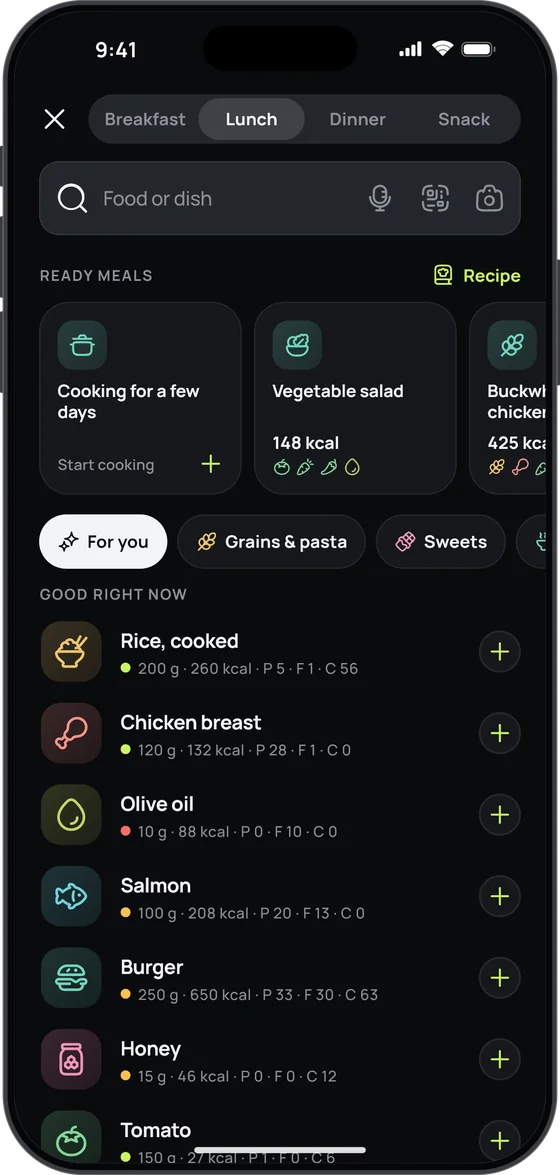
Snap your plate or just say what you ate — 17 Fit recognises the dishes, estimates the grams and counts the calories, macros, vitamins and minerals.
- Photo, voice or a search among 2,592 foods and dishes
- A plan that adjusts to your weight every week
- Free food diary, no sign-up and no ads


Where these numbers come from
USDA FoodData Central (SR Legacy, USA), code 168917.
The vitamins and minerals it lacked come from BLS (Germany).
Carbs are available carbohydrates, without fibre, as on EU labels.