17 Fit Food calories Nuts and seeds
Poppy seeds calories and nutrition facts
Poppy seeds: 525 kcal per 100 g, protein 18 g, fat 41.6 g, carbs 8.6 g. 1 tsp (3 g): 16 kcal.
Blue-gray poppy seeds give lemon poppy seed muffins, bagels and bread rolls their crunch, and in Central Europe they’re ground into sweet fillings for strudel and yeast cakes. They have about 525 kcal per 100 g and are rich in calcium, magnesium and fiber, but a teaspoon weighs just 3 g and adds about 16 kcal. A thick poppy seed filling is a different matter – weigh that.
- Source of protein
- High in fibre
- Very low salt
- High in manganese
- Protein 14%
- Fat 71%
- Carbs 7%
- Other 8%
In everyday portions
- 1 tsp ≈ 3 g 16 kcal P 0.5 · F 1.2 · C 0.3 g
- Typical serving · 10 g 53 kcal P 1.8 · F 4.2 · C 0.9 g
- 100 kcal is 19 g this much of it gives 100 kcal
- 20 g of protein is 110 g this much to eat for 20 g of protein
- Energy density High 5.3 kcal per gram: the lower it is, the more food you get for the same calories
Nutrition per 100 g
The percentage is the share of an adult’s daily reference intake set by the EU (Regulation 1169/2011). What the % means
Energy and macros
- Energy 525 kcal 2,197 kJ 26%
- Protein 18 g 36%
- Fat 41.6 g 59%
- Carbs available, without fibre 8.6 g 3%
- Fibre 19.5 g
- Salt 0.07 g 1%
Where the calories come from
- Protein 14%
- Fat 71%
- Carbs 7%
- Other 8%
Protein and carbs give 4 kcal a gram, fat 9. “Other” is fibre, alcohol and organic acids.
Vitamins
- Vitamin A 0 µg 0%
- Vitamin D 0 µg 0%
- Vitamin E 1.8 mg 15%
- Vitamin K 0 µg 0%
- Vitamin C 1 mg 1%
- Vitamin B1 thiamin 0.854 mg 78%
- Vitamin B2 riboflavin 0.1 mg 7%
- Vitamin B3 niacin 0.896 mg 6%
- Vitamin B5 pantothenic acid 0.324 mg 5%
- Vitamin B6 0.247 mg 18%
- Folate B9 82 µg 41%
- Vitamin B12 0 µg 0%
- Choline 8.8 mg
Minerals
- Potassium 719 mg 36%
- Calcium 1,438 mg 180%
- Phosphorus 870 mg 124%
- Magnesium 347 mg 93%
- Iron 9.8 mg 70%
- Zinc 7.9 mg 79%
- Copper 1.6 mg 163%
- Manganese 6.7 mg 335%
- Selenium 13.5 µg 25%
- Iodine no data
- Sodium 26 mg 1%
EU criteria for nutrition claims
Which of them 100 g of this food meets under Regulation (EC) 1924/2006.
- Source of protein
- High in fibre
- Very low salt
- High in manganese
- High in calcium
- High in copper
- High in phosphorus
- High in magnesium
- High in zinc
- High in vitamin B1
- High in iron
- High in folate
- High in potassium
- Source of selenium
- Source of vitamin B6
Nuts and seeds
Among nuts and seeds
The category in the 17 Fit catalog: 51 foods. Compared per 100 g.
- 84% Fewer calories than 84% of nuts and seeds.
- 93% More fibre than 93% of nuts and seeds.
- 94% More manganese than 94% of nuts and seeds.
- 98% More calcium than 98% of nuts and seeds.
- 88% More phosphorus than 88% of nuts and seeds.
Similar in composition
The foods with the nearest calories and macros.
- Flaxseed 534 kcal
- Pistachios 560 kcal
- Cashews 553 kcal
- Sesame seeds 573 kcal
- Honey roasted almonds 594 kcal
- Peanuts 567 kcal
More in Nuts and seeds
- Sweetened coconut flakes 501 kcal
- Sunflower seed butter 617 kcal
- Peanut butter 588 kcal
- Almonds 579 kcal
- Walnuts 654 kcal
- Chia seeds 486 kcal
17 Fit
Count calories without scales or tables
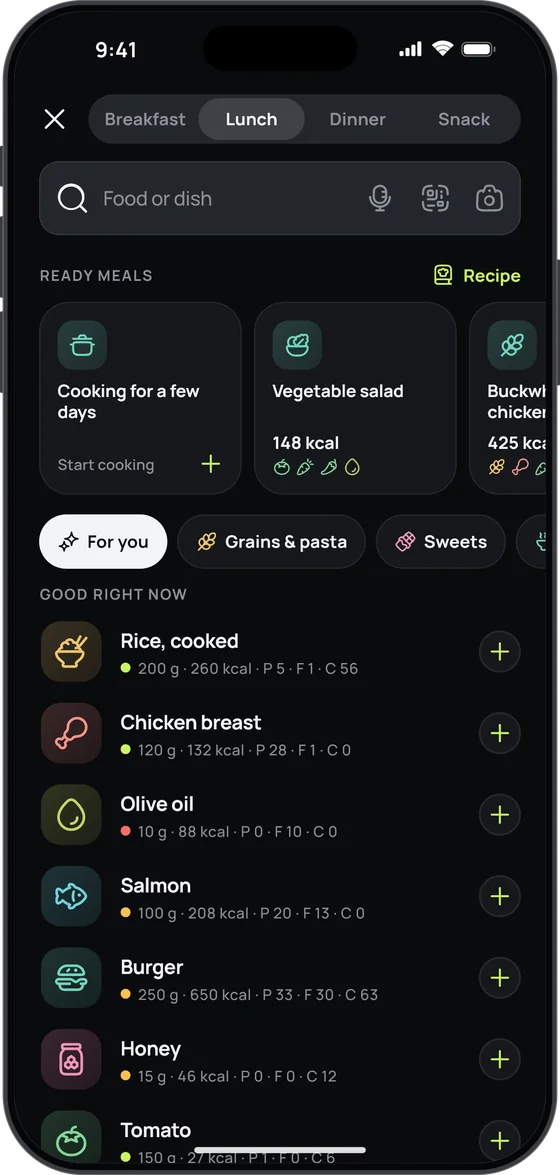
Snap your plate or just say what you ate — 17 Fit recognises the dishes, estimates the grams and counts the calories, macros, vitamins and minerals.
- Photo, voice or a search among 2,592 foods and dishes
- A plan that adjusts to your weight every week
- Free food diary, no sign-up and no ads


Where these numbers come from
USDA FoodData Central (SR Legacy, USA), code 171330.
Carbs are available carbohydrates, without fibre, as on EU labels.