Cheeseburger calories and nutrition facts
Cheeseburger: 296 kcal per 100 g, protein 17.9 g, fat 16.1 g, carbs 18.1 g. 1 piece (210 g): 622 kcal.
In most US diners and drive-thrus, the cheese on a cheeseburger is a slice of American cheese, melted over a beef patty in a soft bun, usually with pickles, onion, ketchup and mustard. A 210 g cheeseburger comes to about 620 kcal, but a small fast-food one is much lighter and a stacked gourmet burger far heavier, so adjust the weight to match yours. It’s also rich in vitamin B12, selenium and zinc.
- High in protein
- High in vitamin B12
- High in selenium
- High in zinc
- Protein 25%
- Fat 50%
- Carbs 25%
In everyday portions
- 1 piece ≈ 210 g 622 kcal P 37.5 · F 33.9 · C 38 g
- 100 kcal is 34 g this much of it gives 100 kcal
- 20 g of protein is 110 g this much to eat for 20 g of protein
- Energy density Medium 3 kcal per gram: the lower it is, the more food you get for the same calories
Nutrition per 100 g
The percentage is the share of an adult’s daily reference intake set by the EU (Regulation 1169/2011). What the % means
Energy and macros
- Energy 296 kcal 1,238 kJ 15%
- Protein 17.9 g 36%
- Fat 16.1 g 23%
- Carbs available, without fibre 18.1 g 7%
- Fibre 0.6 g
- Salt 1.1 g 18%
Where the calories come from
- Protein 25%
- Fat 50%
- Carbs 25%
Protein and carbs give 4 kcal a gram, fat 9. “Other” is fibre, alcohol and organic acids.
Vitamins
- Vitamin A 34 µg 4%
- Vitamin D 0.243 µg 5%
- Vitamin E 0.19 mg 2%
- Vitamin K 3.2 µg 4%
- Vitamin C 0.5 mg <1%
- Vitamin B1 thiamin 0.08 mg 7%
- Vitamin B2 riboflavin 0.161 mg 12%
- Vitamin B3 niacin 3.2 mg 20%
- Vitamin B5 pantothenic acid 0.2 mg 3%
- Vitamin B6 0.255 mg 18%
- Folate B9 18.1 µg 9%
- Vitamin B12 1.6 µg 65%
- Choline 46.2 mg
Minerals
- Potassium 219 mg 11%
- Calcium 126 mg 16%
- Phosphorus 198 mg 28%
- Magnesium 22 mg 6%
- Iron 1.7 mg 12%
- Zinc 3.1 mg 31%
- Copper 0.083 mg 8%
- Manganese 0.23 mg 12%
- Selenium 23.6 µg 43%
- Iodine 7 µg 5%
- Sodium 438 mg 18%
EU criteria for nutrition claims
Which of them 100 g of this food meets under Regulation (EC) 1924/2006.
- High in protein
- High in vitamin B12
- High in selenium
- High in zinc
- Source of phosphorus
- Source of vitamin B3
- Source of vitamin B6
- Source of calcium
Dishes
Among dishes
The category in the 17 Fit catalog: 699 foods. Compared per 100 g.
- 94% More calories than 94% of dishes.
- 93% More protein than 93% of dishes.
- 96% More vitamin B12 than 96% of dishes.
- 92% More selenium than 92% of dishes.
- 95% More zinc than 95% of dishes.
Similar in composition
The foods with the nearest calories and macros.
- Korean fried chicken 279 kcal
- Chicken tenders 271 kcal
- General Tso’s chicken 295 kcal
- Toad in the hole 285 kcal
- Chicken nuggets 307 kcal
- Tuna melt 296 kcal
More in Dishes
- Shepherd’s pie 123 kcal
- Chicken pot pie 255 kcal
- Clam chowder 93 kcal
- Cobb salad 93 kcal
- Potato salad 168 kcal
- Barbecue ribs 254 kcal
17 Fit
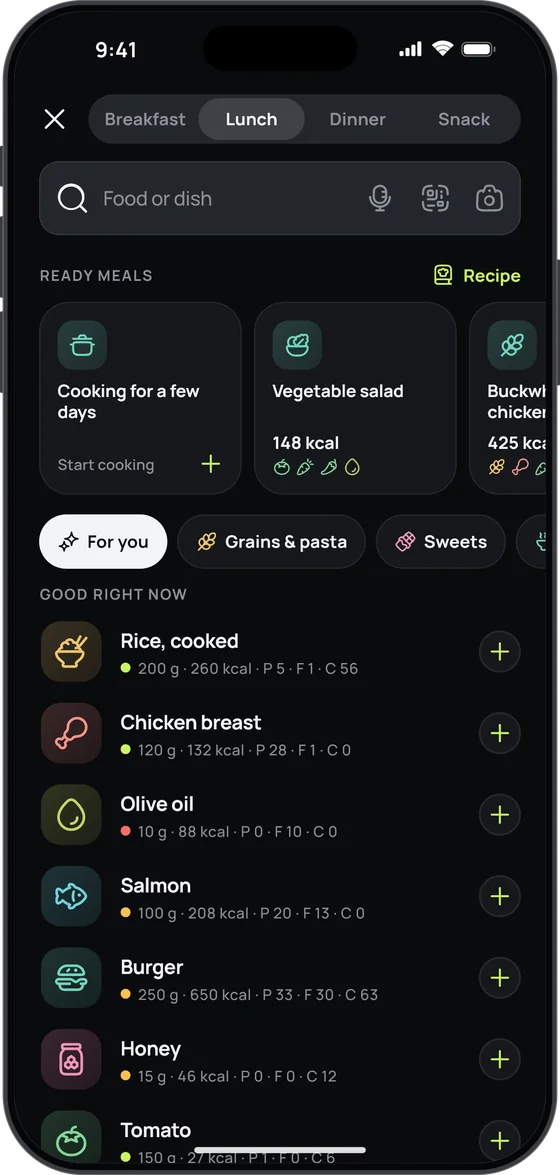
Count calories without scales or tables
Snap your plate or just say what you ate — 17 Fit recognises the dishes, estimates the grams and counts the calories, macros, vitamins and minerals.
- Photo, voice or a search among 2,592 foods and dishes
- A plan that adjusts to your weight every week
- Free food diary, no sign-up and no ads


Where these numbers come from
USDA FoodData Central (FNDDS, USA), code 2706901.
The vitamins and minerals it lacked come from BLS (Germany).
Without what US law adds to flour, milk and juice: those vitamins and minerals are the food’s as made in Europe.
Carbs are available carbohydrates, without fibre, as on EU labels.