17 Fit Kalorientabelle Ranglisten
Vitamin-B12-reiche Lebensmittel pro 100 g und pro Portion
233 Lebensmittel bei 17 Fit erfüllen das EU‑Kriterium „Quelle von Vitamin B12“. Am meisten pro 100 g: Rinderleber (Geschmort), Kalbsleber und Oktopus (Gekocht).
Vitamin B12 kommt in nennenswerten Mengen nur in Lebensmitteln tierischer Herkunft vor: Rinder- und Kalbsleber liegen mit 65 bis 70 µg pro 100 g weit vorn, dahinter gekochter Oktopus, Schweine- und Hühnerleber, Makrele, Hering, Miesmuscheln, Austern, Sardinen und Leberwurst, dann Fleisch, Käse und Eier. Pflanzliche Lebensmittel enthalten praktisch keines, solange es nicht zugesetzt wird; angereicherte Produkte wie Cornflakes oder Energydrinks stehen nicht in der Rangliste. Die EU‑Referenzmenge ist klein, 2,5 µg am Tag für Erwachsene, deshalb erreichen viele alltägliche Lebensmittel sie mit einer einzigen Portion, wie die Portionsspalte zeigt.
Die Top 10 pro 100 g
- 1 Rinderleber · Geschmort 70,6 µg 2823% · hoher Gehalt
- 2 Kalbsleber 65,6 µg 2624% · hoher Gehalt
- 3 Oktopus · Gekocht 36 µg 1440% · hoher Gehalt
- 4 Rindernieren 27,5 µg 1100% · hoher Gehalt
- 5 Schweineleber 26 µg 1040% · hoher Gehalt
- 6 Hühnerleber · Gebraten 21,1 µg 845% · hoher Gehalt
- 7 Makrele · Gebacken 19 µg 760% · hoher Gehalt
- 8 Hering · Bückling 18,7 µg 748% · hoher Gehalt
- 9 Miesmuscheln · Gekocht 17,6 µg 704% · hoher Gehalt
- 10 Austern 16,2 µg 648% · hoher Gehalt
Die ganze Liste
Werte pro 100 g und für eine übliche Portion. Tippe auf eine Spaltenüberschrift, um danach zu sortieren.
| Lebensmittel | |||||
|---|---|---|---|---|---|
| 1 | Rinderleber · GeschmortTypische Portion · 100 g | 70,6 µg | 2823% | 70,6 µg | 191 |
| 2 | KalbsleberTypische Portion · 100 g | 65,6 µg | 2624% | 65,6 µg | 86 |
| 3 | Oktopus · GekochtTypische Portion · 100 g | 36 µg | 1440% | 36 µg | 156 |
| 4 | RindernierenTypische Portion · 150 g | 27,5 µg | 1100% | 41,3 µg | 99 |
| 5 | SchweineleberTypische Portion · 150 g | 26 µg | 1040% | 39 µg | 134 |
| 6 | Hühnerleber · GebratenTypische Portion · 100 g | 21,1 µg | 845% | 21,1 µg | 172 |
| 7 | Makrele · GebackenTypische Portion · 150 g | 19 µg | 760% | 28,5 µg | 262 |
| 8 | Hering · BücklingTypische Portion · 80 g | 18,7 µg | 748% | 15 µg | 217 |
| 9 | Miesmuscheln · GekochtTypische Portion · 150 g | 17,6 µg | 704% | 26,4 µg | 108 |
| 10 | Austern1 Stück ≈ 15 g | 16,2 µg | 648% | 2,4 µg | 59 |
| 11 | Sardellen · MariniertTypische Portion · 50 g | 15,3 µg | 612% | 7,7 µg | 136 |
| 12 | Sardinen · In Olivenöl (Dose)Typische Portion · 100 g | 13,7 µg | 548% | 13,7 µg | 202 |
| 13 | Krabbenfleisch · Aus der DoseTypische Portion · 60 g | 13,5 µg | 540% | 8,1 µg | 111 |
| 14 | LeberwurstTypische Portion · 30 g | 13,5 µg | 538% | 4 µg | 326 |
| 15 | VenusmuschelnTypische Portion · 100 g | 11,3 µg | 451% | 11,3 µg | 86 |
| 16 | SprottenTypische Portion · 100 g | 10,4 µg | 416% | 10,4 µg | 186 |
| 17 | Lachskaviar1 EL ≈ 15 g | 10 µg | 400% | 1,5 µg | 143 |
| 18 | RäuchermakreleTypische Portion · 100 g | 9,9 µg | 396% | 9,9 µg | 294 |
| 19 | HühnerherzenTypische Portion · 150 g | 7,3 µg | 292% | 10,9 µg | 153 |
| 20 | KaninchenTypische Portion · 150 g | 7,2 µg | 286% | 10,7 µg | 136 |
| 21 | HirschfleischTypische Portion · 150 g | 6,3 µg | 252% | 9,5 µg | 120 |
| 22 | MatjesTypische Portion · 50 g | 6,2 µg | 248% | 3,1 µg | 177 |
| 23 | KlippfischTypische Portion · 50 g | 5,4 µg | 217% | 2,7 µg | 206 |
| 24 | Tintenfisch · GekochtTypische Portion · 100 g | 5,3 µg | 212% | 5,3 µg | 98 |
| 25 | Buckellachs · Aus der DoseTypische Portion · 100 g | 5 µg | 198% | 5 µg | 138 |
| 26 | ForelleTypische Portion · 150 g | 4,3 µg | 172% | 6,5 µg | 141 |
| 27 | RinderfiletTypische Portion · 150 g | 3,9 µg | 156% | 5,8 µg | 121 |
| 28 | RotbarschTypische Portion · 150 g | 3,8 µg | 152% | 5,7 µg | 92 |
| 29 | RinderzungeTypische Portion · 100 g | 3,8 µg | 152% | 3,8 µg | 224 |
| 30 | Lachs · GegrilltTypische Portion · 150 g | 3,4 µg | 136% | 5,1 µg | 223 |
| 31 | RäucherlachsTypische Portion · 50 g | 3,4 µg | 134% | 1,7 µg | 178 |
| 32 | Rinderhackfleisch · 20 % Fett, gebratenTypische Portion · 120 g | 3,3 µg | 132% | 4 µg | 265 |
| 33 | EntenbrustTypische Portion · 150 g | 3,3 µg | 132% | 5 µg | 222 |
| 34 | DoradeTypische Portion · 150 g | 3,2 µg | 126% | 4,7 µg | 129 |
| 35 | Emmentaler1 Scheibe ≈ 20 g | 3,1 µg | 122% | 0,61 µg | 393 |
| 36 | Graved Lachs1 Scheibe ≈ 15 g | 3 µg | 121% | 0,46 µg | 212 |
| 37 | AalTypische Portion · 100 g | 3 µg | 120% | 3 µg | 184 |
| 38 | Corned Beef1 Scheibe ≈ 30 g | 3 µg | 120% | 0,9 µg | 142 |
| 39 | PferdefleischTypische Portion · 150 g | 3 µg | 120% | 4,5 µg | 133 |
| 40 | ThunfischTypische Portion · 100 g | 3 µg | 120% | 3 µg | 116 |
| 41 | Wels · Amerikanischer Katzenwels, rohTypische Portion · 150 g | 2,9 µg | 115% | 4,3 µg | 119 |
| 42 | Salami · Aus Schweinefleisch1 Scheibe ≈ 10 g | 2,8 µg | 112% | 0,28 µg | 400 |
| 43 | SaiblingTypische Portion · 150 g | 2,8 µg | 111% | 4,2 µg | 109 |
| 44 | Lammfleisch · Schulter, gebratenTypische Portion · 150 g | 2,7 µg | 109% | 4,1 µg | 252 |
| 45 | Rindersteak · GegrilltTypische Portion · 200 g | 2,7 µg | 108% | 5,4 µg | 128 |
| 46 | Bergkäse1 Scheibe ≈ 20 g | 2,7 µg | 108% | 0,54 µg | 395 |
| 47 | PaneerTypische Portion · 50 g | 2,6 µg | 105% | 1,3 µg | 328 |
| 48 | Prime RibTypische Portion · 200 g | 2,5 µg | 102% | 5,1 µg | 365 |
| 49 | Steinbutt · GebackenTypische Portion · 150 g | 2,5 µg | 102% | 3,8 µg | 118 |
| 50 | RinderbrustTypische Portion · 150 g | 2,4 µg | 97% | 3,6 µg | 157 |
| 51 | LammhackfleischTypische Portion · 150 g | 2,3 µg | 92% | 3,5 µg | 282 |
| 52 | Hecht · GebackenTypische Portion · 150 g | 2,3 µg | 92% | 3,5 µg | 113 |
| 53 | Flusskrebse · GekochtTypische Portion · 100 g | 2,3 µg | 90% | 2,3 µg | 82 |
| 54 | RindfleischTypische Portion · 150 g | 2,2 µg | 90% | 3,4 µg | 170 |
| 55 | Mettwurst1 Scheibe ≈ 10 g | 2,2 µg | 88% | 0,22 µg | 349 |
| 56 | Köfte1 Stück ≈ 50 g | 2,2 µg | 88% | 1,1 µg | 290 |
| 57 | Hackfleisch gemischtTypische Portion · 150 g | 2,1 µg | 84% | 3,1 µg | 250 |
| 58 | BackfischTypische Portion · 180 g | 2,1 µg | 84% | 3,8 µg | 240 |
| 59 | Tilsiter1 Scheibe ≈ 20 g | 2,1 µg | 84% | 0,42 µg | 340 |
| 60 | SeelachsTypische Portion · 150 g | 2,1 µg | 84% | 3,1 µg | 100 |
Pro 100 g genug für die Rangliste, aber jeweils nur in kleinen Mengen gegessen – etwa eine Prise, ein Teelöffel oder eine dünne Scheibe – und deshalb nicht darin: Deutscher Kaviar.
Angereicherte Produkte stehen nicht in der Rangliste, weil ihre Werte vom Hersteller stammen: Whey Protein, Cornflakes.
Die Spitzenreiter jeder Kategorie
Die drei Lebensmittel jeder Kategorie mit dem höchsten Gehalt pro 100 g, die das EU‑Kriterium „Quelle von“ erfüllen.
-
Getreide, Hülsenfrüchte und Mehl
- Haferflocken · Haferbrei mit Milch 0,53 µg 21%
-
Brot und Gebäck
- Pandoro 1,4 µg 57%
- Yorkshire Pudding 1 µg 40%
- Empanada 0,82 µg 33%
-
Fleisch und Geflügel
- Rinderleber · Geschmort 70,6 µg 2823%
- Kalbsleber 65,6 µg 2624%
- Rindernieren 27,5 µg 1100%
-
Fisch und Meeresfrüchte
- Oktopus · Gekocht 36 µg 1440%
- Makrele · Gebacken 19 µg 760%
- Hering · Bückling 18,7 µg 748%
-
Milchprodukte und Eier
- Emmentaler 3,1 µg 122%
- Bergkäse 2,7 µg 108%
- Paneer 2,6 µg 105%
-
Öle, Soßen und Würzmittel
- Salatcreme 0,5 µg 20%
-
Süßigkeiten und Desserts
- Vanillesoße 1 µg 40%
- Crêpes · Mit Fleischfüllung 0,8 µg 32%
- Vollmilchschokolade 0,75 µg 30%
-
Getränke
- Tee · Matcha Latte 0,51 µg 20%
- Goldene Milch 0,493 µg 20%
- Eggnog 0,45 µg 18%
-
Gerichte
- Nudelgerichte · Alle Vongole 7,9 µg 316%
- Rinderbraten 3,2 µg 127%
- Rinderrouladen 2 µg 82%
-
Snacks, Gewürze und mehr
- Fischsoße 0,48 µg 19%
- Tzatziki 0,42 µg 17%
- Austernsoße 0,41 µg 16%

So entsteht die Liste
Die Werte gelten für 100 g des essbaren Anteils und stammen aus dem Katalog von 17 Fit. Gibt es ein Lebensmittel in mehreren Varianten (frisch, getrocknet, gegart), zählt die mit dem höchsten Gehalt; die Zeile nennt sie. Die Prozentwerte beziehen sich auf die EU‑Referenzmenge von 2,5 µg am Tag für einen Erwachsenen (Verordnung (EU) Nr. 1169/2011). „Quelle von“ bedeutet mindestens 15 % davon pro 100 g, „hoher Gehalt an“ mindestens 30 %; bei Getränken gilt jeweils die Hälfte pro 100 ml (Verordnung (EG) Nr. 1924/2006).
17 Fit
Kalorien zählen ohne Waage und Tabellen
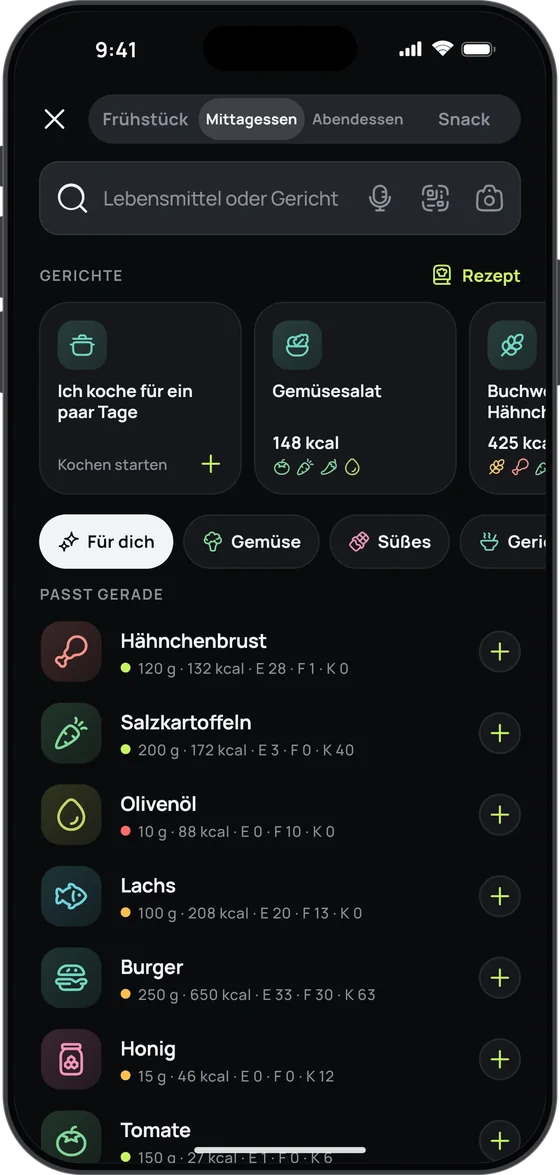
Fotografiere deinen Teller oder sag einfach, was du gegessen hast – 17 Fit erkennt die Gerichte, schätzt die Gramm und zählt Kalorien, Makros, Vitamine und Mineralstoffe.
- Foto, Sprache oder Suche unter 2.592 Lebensmitteln und Gerichten
- Ein Plan, der sich jede Woche deinem Gewicht anpasst
- Kostenloses Ernährungstagebuch, ohne Registrierung und ohne Werbung